AI for law firms, with every result linked to its source
A general AI assistant doesn’t know your matters, your precedents or your review standard. We advise UK law firms on where AI is worth using, then build the tools ourselves, on your own documents and official court data, so every answer can be checked by a lawyer.
6 fields · 1 date normalised · 14 citations linked
UK judgmentvia CasePulse
Neutral citation [2026] EWHC 2319 (TCC)
Case No HT-2026-000118 · Before Mr Justice Eyre
Coventry & Warwickshire Development Partnership LLP v Avison Young (UK) Limited
1. From January 2020 to January 2023 the Defendant was engaged by the Claimant to act as NEC project manager and NEC supervisor in relation to the Claimant’s development works at Gateway South in Coventry. … The Claimant referred the matter to adjudication and by his decision (“the Decision”) of 13 th February 2026 Franco Mastrandrea (“the Adjudicator”) awarded the Claimant £8,729,179.33 plus interest as damages.
[2026] EWHC 2319 (TCC), The National Archives, Open Justice Licence. Indexed by CasePulse.
A real judgment indexed by CasePulse and ContractScanner’s sample agreement. Hover over or tap any value to see where it came from. The demo pauses while you read.
What we’ve shipped for legal
Legal AI tools you can try today
Two free tools and a live product on web, iOS and Android, built on the same foundations we would use for your firm.
Live Product · iOS · Android · Web
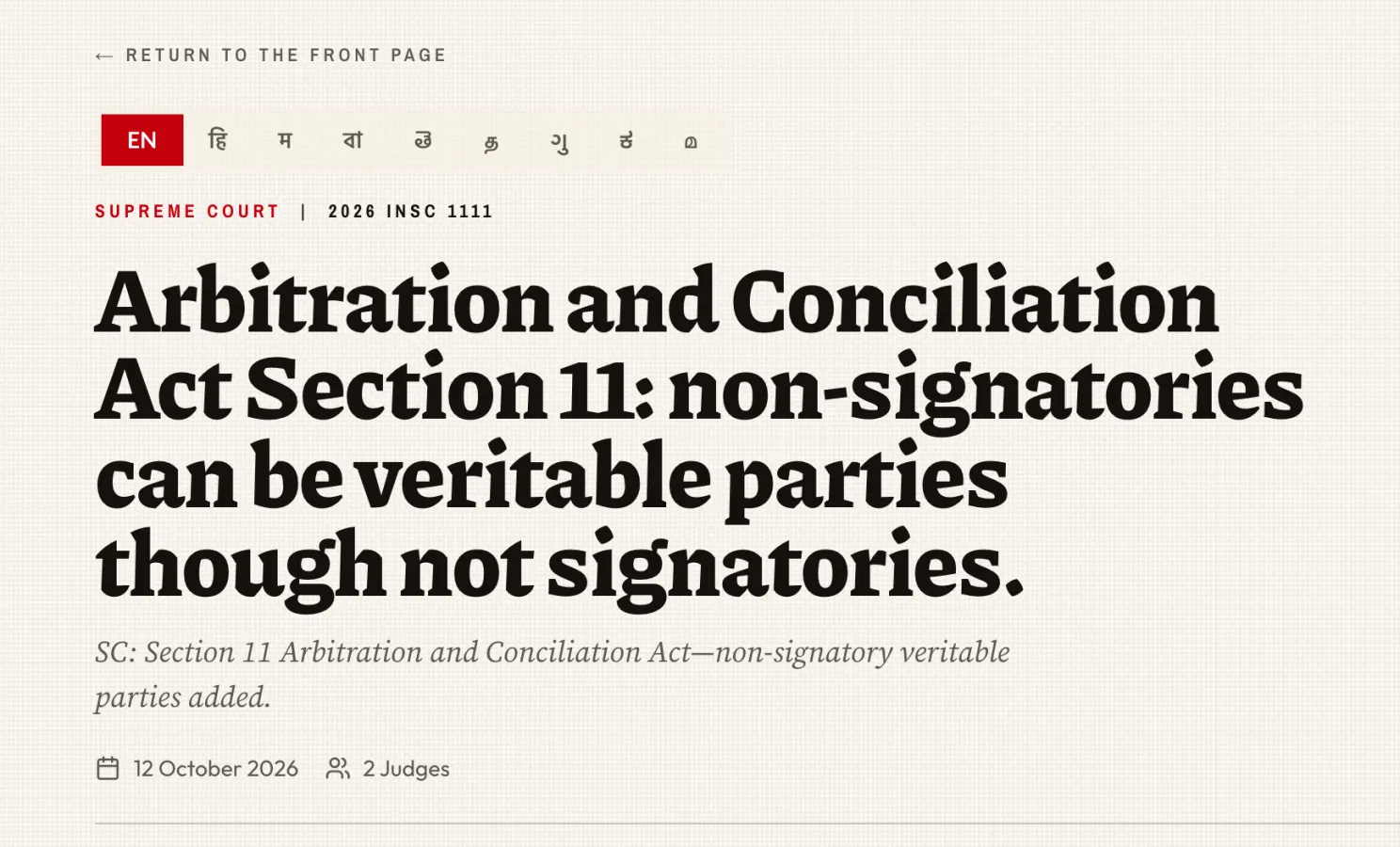
Supreme Court Judgment Analysis
Law AajKal
Full consumer product for Indian legal professionals. Instant summaries of Supreme Court judgments, hourly push notifications on new rulings, and smart search by case number, parties, date, or topic. React Native mobile apps, subscription billing, server-side parsing of 75,000+ judgments, daily ingestion.
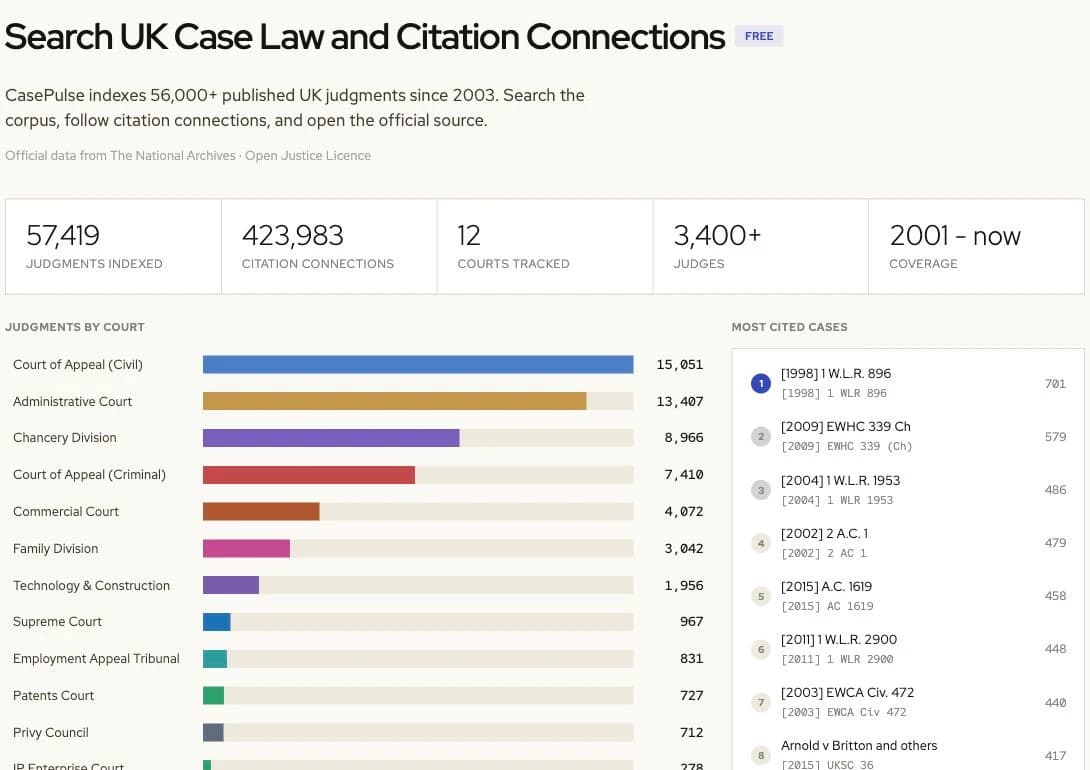
56,000+ UK court judgments since 2003, with 411,000+ citation connections. Searchable, filterable by practice area, with judge profiles. Updated daily from The National Archives via automated ingestion pipeline.
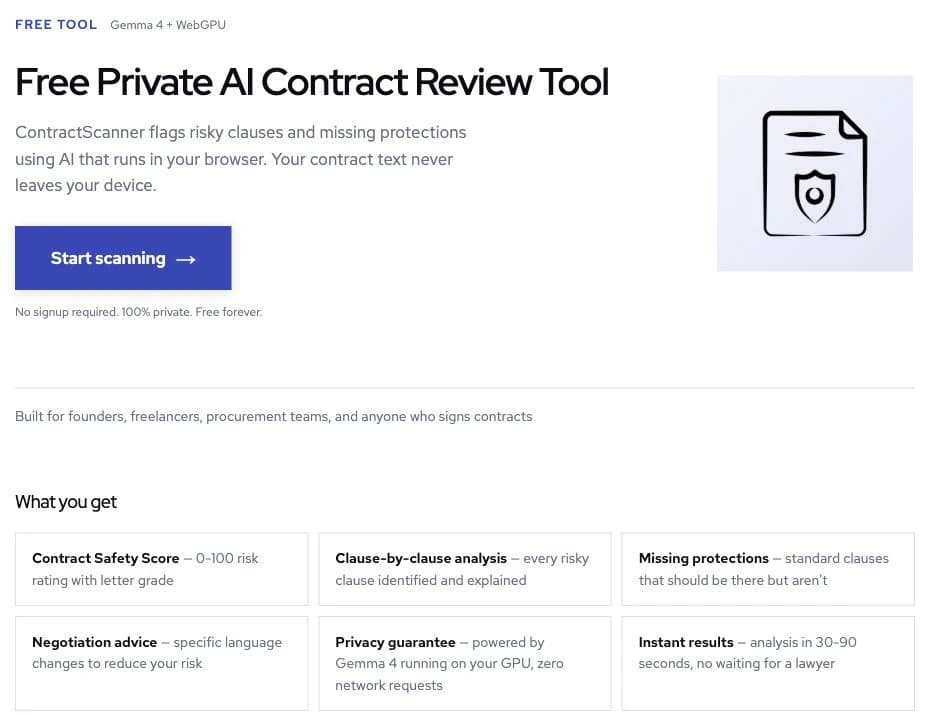
Paste a contract and get a first-pass risk review. The model runs in your browser after you choose to load it, so the contract text is never sent to a server.
All three share the same foundations: automated ingestion from official sources, structured parsing, citation graphs and search. What we would build for your firm would be tuned to your practice areas, your own documents and your workflows.
How we build
Our tools are built on official data sources and on-device processing where possible, so client confidentiality depends on the architecture rather than on a policy document.
Official court data, not generated text
CasePulse sources judgments directly from The National Archives under the Open Justice Licence. Every judgment is the official published version, with no generated text standing in for it.
Privacy by design
ContractScanner runs entirely in your browser. The contract text is not sent to any server; it stays on your device.
Human-in-the-loop by default
We design tools that support a lawyer’s professional judgement. Every automation has a review step: outputs are drafts, not decisions.
What we build for legal teams
Custom AI for your practice
Case law monitoring
Daily updates on judgments that matter to your practice areas. Commercial, Chancery, Family, IP, Criminal: filtered, summarised, and delivered to your team before their first meeting of the day.
Internal knowledge search
Your firm has years of precedents, opinions and advice in its document management system. We build search that lets lawyers ask in plain English and find relevant past work, with each result linked to the original document.
Document review and drafting
First drafts from your firm’s own templates. Contract risk flagging against your standard positions. Disclosure review support designed to shorten first-pass review, with lawyers checking every output.
AI readiness assessment
Where could AI save your firm the most time? A focused assessment that maps your workflows, ranks the opportunities and sets out recommendations your partnership can act on, with the estimated impact and the assumptions behind it.
A free 8-module course on adopting AI responsibly in legal practice: contract review, legal research, disclosure, matter management, regulatory monitoring and professional ethics.
Starts with your workflows rather than with tools. We look at how a piece of work moves through your firm, identify where AI could save fee-earner time, and set out recommendations with the assumptions behind them. If you go ahead, we build the tools ourselves, so the people who advised you are accountable for what gets built.
How much does AI consulting for a law firm cost?
It depends on the documents, the systems involved and how many exceptions the workflow has, so we scope it after one conversation. Builds are fixed-scope projects: the proposal states the price, what will be working, what stays manual and what production would still need, before you commit.
Is client data safe with AI tools?
Only if the architecture makes it safe. We design tools where confidentiality is built in: on-device processing where possible (ContractScanner never sends contract text to a server), UK or EU data residency where not, and no client data used to train third-party models.
Which size of firm are your services designed for?
Independent firms with roughly 20 to 100 lawyers, especially litigation and regulatory teams, and barristers' chambers. Large enough to have years of past matters worth reusing, small enough that an in-house AI team doesn't make sense.
Do you take on firms across the UK?
Yes: London, Manchester, Birmingham, Leeds, Scotland and everywhere in between. Engagements run remotely, with on-site sessions where useful.
Tell us which piece of legal work you’d like AI to take on, such as finding precedent across past matters, and what it runs on today. We’ll reply by email with what we would build, what stays with your lawyers, and what a first version would take. You don’t need to send any documents.