
Build notes / Legal technology
CasePulse build note
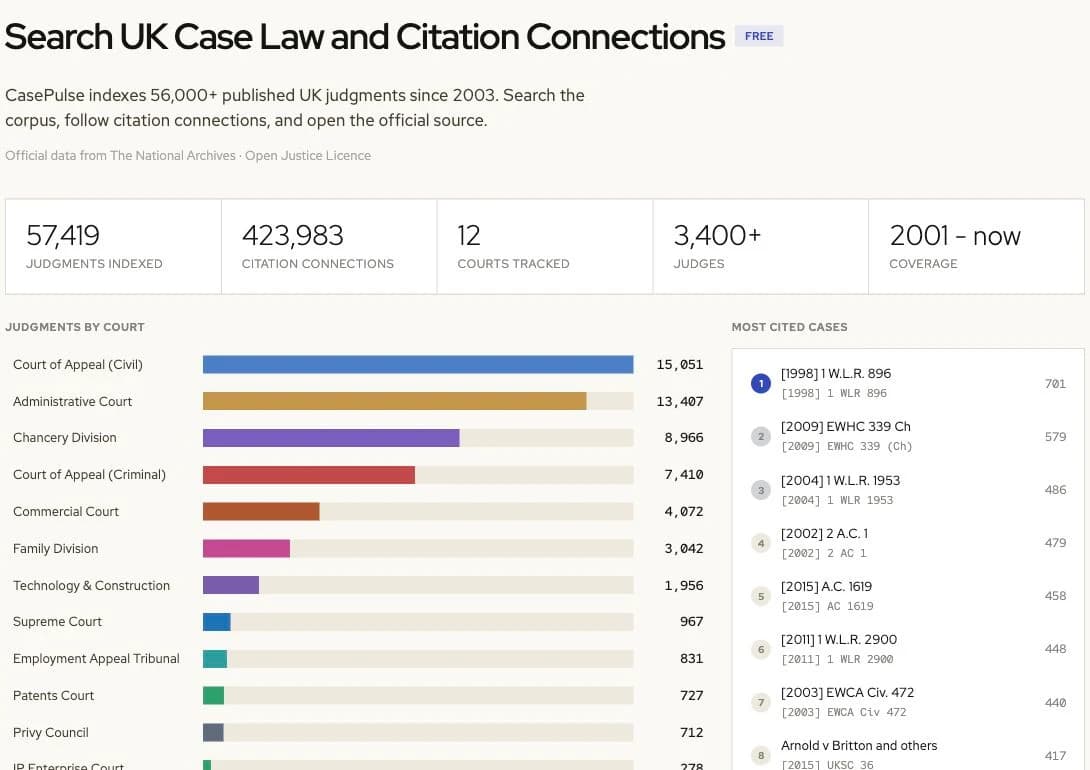
A searchable UK judgment index with citation connections, source provenance, and daily updates from The National Archives.
The operating problem
New judgments arrive continuously, while legal professionals often need to search across courts, parties, judges, topics, and the authorities cited inside a decision. A conventional list of documents does not show how cases connect.
The product therefore needed two things at once: a dependable document pipeline with source provenance, and a research interface that makes a large public corpus navigable without implying that automated retrieval is legal advice.
How we approached it
CasePulse ingests public judgment material from The National Archives' Find Case Law service, normalises court and judgment metadata, and turns cited authorities into connections that can be explored alongside ordinary keyword and field search.
The interface keeps the original judgment source available. Search and citation context help a user discover material; the authoritative text remains the published judgment itself.
What was built
- A repeatable ingestion process for published UK judgments and metadata.
- Normalisation for courts, dates, parties, judges, neutral citations, and practice-area filters.
- A citation graph connecting judgments to the authorities referenced in their text.
- Search and filtering designed for fast research across a changing document corpus.
- Source links and product language that preserve the distinction between research support and legal advice.
Constraints and trade-offs
- Public source structure and metadata quality vary across decisions.
- Judgment names, citations, and court labels need consistent normalisation before filters are useful.
- Citation extraction must remain inspectable because an apparent textual reference is not always a legal citation.
- Freshness claims need to be tied to actual source ingestion rather than a marketing timestamp.
Evidence you can inspect
- The working CasePulse interface can be opened and searched without a sales call.
- The source corpus is independently available from The National Archives.
- The product currently presents 56,000+ judgments and 411,000+ citation connections; these are corpus counts, not fabricated customer-impact metrics.
What this demonstrates
The same pattern applies to regulated document products: preserve provenance, structure the corpus, expose uncertainty, and make every generated or extracted result traceable to source material.
ContractScanner
Prototype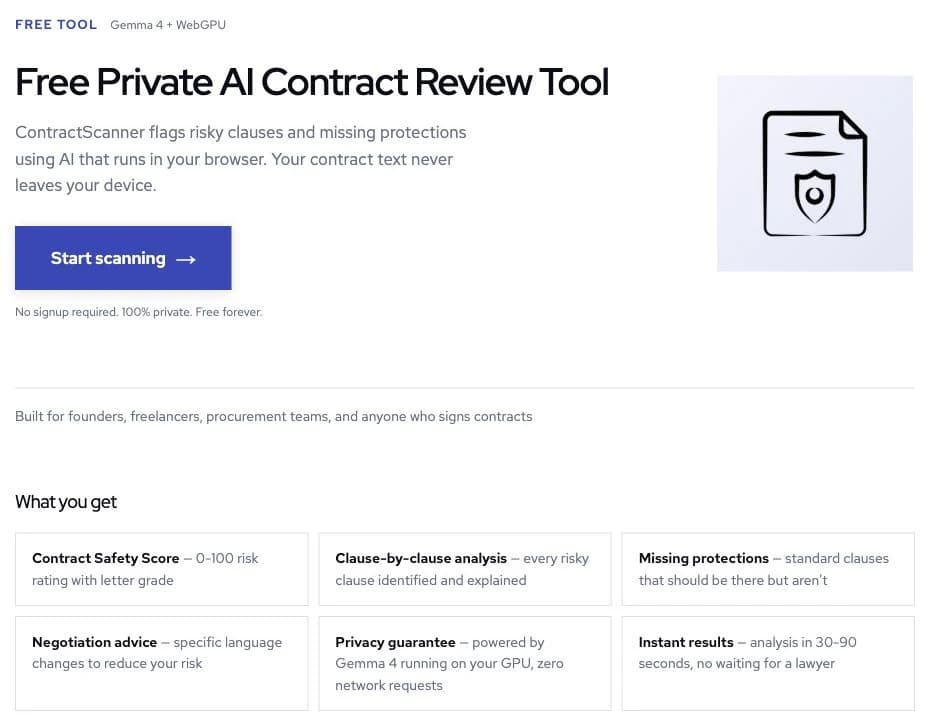
Contract triage that runs in the browser; the text never leaves the device.
The model runs locally via WebGPU after you choose to load it. No contract text is posted to a SupaMakers server.