
Most companies are no longer asking whether AI matters.
They are asking why all the access, pilots, licences, demos, and internal enthusiasm have not turned into a different operating model.
That is the AI-native gap.
Using ChatGPT, Claude, Gemini, Copilot, Cursor, or an internal chatbot does not make a company AI native. It makes the company AI assisted. Useful, but not enough.
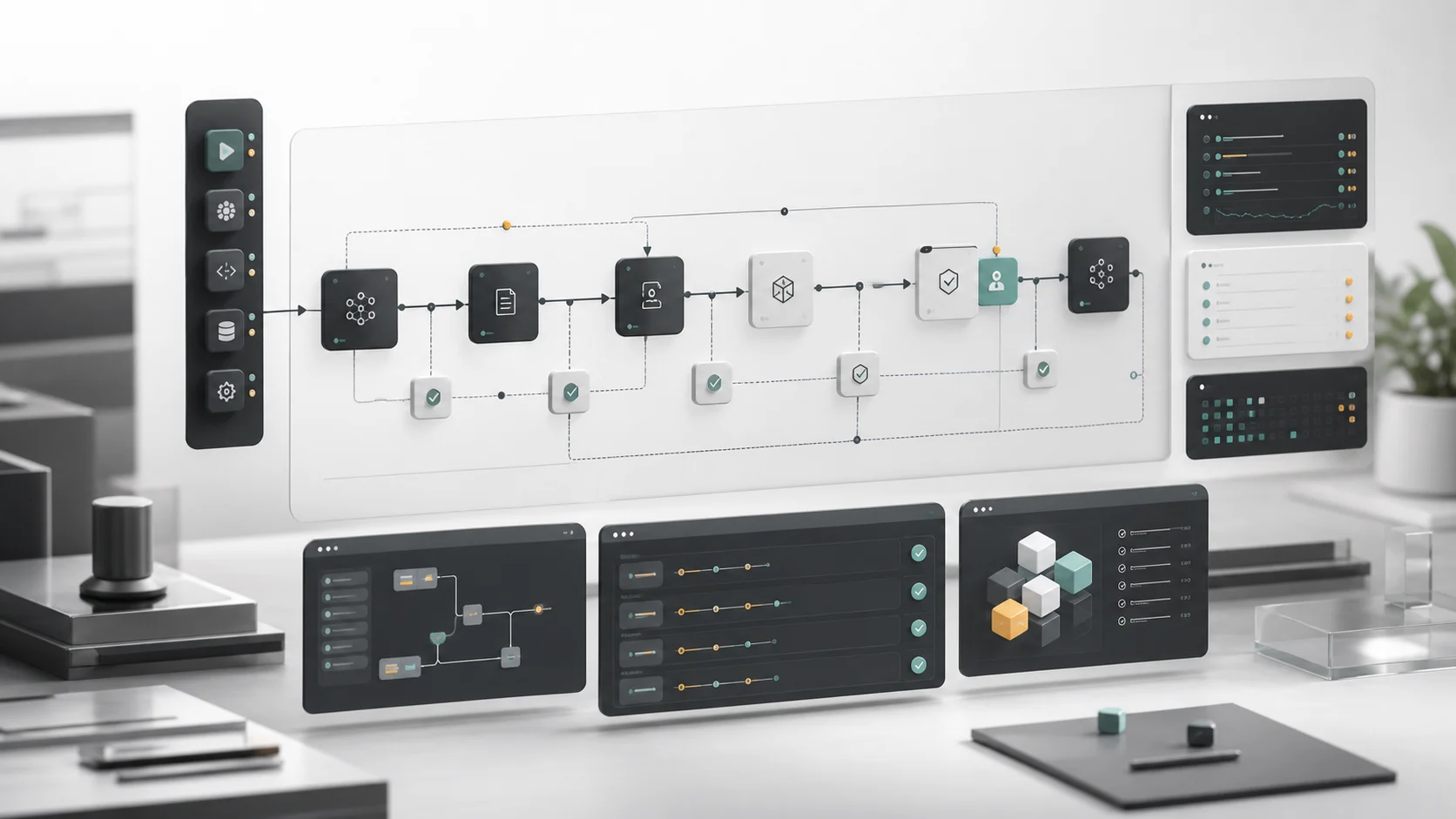
An AI-native company is different. It has redesigned workflows, AI-readable company context, people who know how to delegate and review work, agentic systems that can operate safely, and governance that measures and improves the system over time.
That is the standard companies need to assess in 2026.
Why This Matters Now
The latest enterprise AI research points in the same direction: adoption is high, but execution readiness is uneven.
Deloitte's 2026 State of AI in the Enterprise reports that worker access to AI rose by 50% in 2025, but companies feel less prepared across infrastructure, data, risk, and talent than they do at the strategy level. It also reports that only one in five companies has a mature governance model for autonomous AI agents.
McKinsey's 2026 AI trust research makes the risk sharper. As AI systems become agentic, companies must govern systems that can take actions, misuse tools, trigger downstream processes, or operate outside intended guardrails. McKinsey found that strategy, governance, and agentic AI controls still lag, with only about 30% of organisations reaching maturity level three or higher in those dimensions.
Stanford HAI's 2026 AI Index shows why the pressure is increasing. Organisational AI adoption reached 88%, and agents are getting better at real computer tasks, but benchmark results still show failure rates that make production controls non-negotiable.
The deeper operational lesson comes from the Stanford Digital Economy Lab Enterprise AI Playbook. Across enterprise AI deployments, the hardest challenges were usually not the model. They were change management, data quality, process redesign, regulatory constraints, and process documentation gaps.
In other words: AI readiness is not a tool purchase. It is an operating system problem.
The Wrong Assessment
Many AI readiness assessments still ask questions like:
- Do you have an AI strategy?
- Have you deployed AI tools?
- Is your data in the cloud?
- Have employees received training?
- Do you have an AI policy?
Those questions are useful, but incomplete.
They measure whether a company has started. They do not measure whether the company can become AI native.
The better question is:
Can your company repeatedly turn AI capability into governed, measurable, workflow-level advantage?
That requires a different scorecard.
The Six Dimensions of AI Native Readiness
SupaMakers' AI Native Readiness Assessment scores six dimensions.
1. Operating Ownership
AI transformation fails when it has no owner, or when it is owned only by technology.
The companies moving fastest usually pair business ownership with technical execution. Someone owns the workflow. Someone owns the systems. Leadership sets the priority, funds the work, removes blockers, and reviews outcomes.
The question is not "Who owns AI?"
The better question is: "Who owns the business workflow that AI is supposed to improve?"
2. Workforce Fluency
Workforce fluency is not prompt training.
It is whether people can use AI in the normal flow of work: delegate a task, provide context, inspect the result, catch failure modes, protect sensitive information, and improve the process.
IBM's 2026 CEO study coverage reports that only 25% of workers use AI regularly as part of their job, even though 86% of CEOs believe their people are ready. That gap is the difference between leadership belief and operating reality.
Training has to move from generic AI awareness to role-specific workflow practice.
3. Workflow Rewiring
AI produces more value when companies redesign workflows instead of accelerating isolated steps.
This is the difference between:
- "Use AI to draft this email faster"
- "Redesign customer follow-up so intake, context gathering, draft generation, approval, CRM update, and learning loop happen in one governed workflow"
McKinsey's prior State of AI research on rewiring for value identified practices such as embedding AI into business processes, tracking KPIs, role-based training, feedback mechanisms, adoption roadmaps, and trust-building as important scaling behaviours.
The workflow is the unit of transformation.
4. AI-Readable Context
AI systems are only as useful as the context they can access and trust.
For most companies, the context layer is weak. SOPs are stale. Knowledge lives in chat, inboxes, slide decks, spreadsheets, and people's heads. Permissions are unclear. Source quality varies. The best examples are hard to find.
AI-native companies treat company knowledge as an operating asset. They organise it, permission it, keep it fresh, and connect it to workflows.
This is where many companies can create a practical advantage without inventing new model technology.
5. Agent Operability
Agents are not magic employees. They are software systems that use models, tools, memory, state, and permissions.
Readiness means the company can answer basic questions:
- What can the agent access?
- What tools can it call?
- What state does the workflow store outside the model?
- What requires human approval?
- What happens when a tool fails?
- How do we audit what happened?
Lenovo's 2026 CIO Playbook coverage reports that 60% of organisations are in late-stage AI adoption, but only 27% have a comprehensive governance framework. It also reports that most organisations are still more than 12 months away from being ready to scale agentic AI across operations.
That is the agent operability gap.
6. Governance & Learning Loop
Governance cannot be a PDF that says "do not paste sensitive data into public tools."
AI-native governance includes:
- approved tools and data boundaries
- human review gates
- audit trails
- output evals
- incident handling
- ROI measurement
- customer and employee feedback
- updates to workflows, prompts, skills, and context
NIST's AI Risk Management Framework remains an important reference for structuring AI risk management, and the European Commission's AI Act timeline makes transparency, GPAI obligations, and high-risk AI governance a board-level concern for many companies operating in or selling into Europe.
The practical rule is simple:
Separate generated work from accepted work.
Generated work is what the model produces. Accepted work is what the company is willing to use, send, publish, or commit to a system of record.
That separation is where trust is built.
What Your Score Means
The free assessment gives a score out of 30.
| Score | Stage | What it usually means |
|---|---|---|
| 1-12 | AI Curious | Individuals are experimenting, but the company has no operating model. |
| 13-18 | AI Assisted | Tools are in use, but workflow change is inconsistent. |
| 19-24 | AI Enabled | Some workflows are redesigned and governed, but scaling is uneven. |
| 25-30 | AI Native Ready | The company has the ownership, context, controls, and workflow discipline to scale. |
The total score is useful, but the bottleneck matters more.
If your lowest score is workflow rewiring, buying better tools will not fix the problem. If your lowest score is AI-readable context, building agents will create weak outputs faster. If your lowest score is governance, adoption will either slow down or move into shadow AI.
The Practical Path
Do the work in this order:
- Assess the six dimensions.
- Select one high-frequency workflow with clear business value.
- Map the workflow: trigger, inputs, decisions, outputs, handoffs, risk, and metrics.
- Build the context pack: SOPs, examples, policies, data sources, permissions, and quality bar.
- Design the AI workflow: tools, state, approvals, verification, and recovery.
- Measure speed, quality, adoption, cost, and business outcome.
- Feed back lessons into the workflow, training, and context layer.
That is how a company moves from AI tools to an AI-native operating system.
Start With the Assessment
Take the free AI Readiness Assessment.
It takes about five minutes and identifies your lowest-scoring dimension. Use that bottleneck to decide what to do next.
For a deeper implementation path, continue into the AI Native Operating System course. It turns the scorecard into a practical operating model: workflow selection, context design, agent workflow architecture, governance, and a 30/60/90 day rollout plan.
If you want SupaMakers to run this with your team, book a strategy call. We can turn the assessment into a facilitated AI-native roadmap for your company.
Sources
- Deloitte, The State of AI in the Enterprise 2026
- McKinsey, State of AI trust in 2026
- Stanford HAI, 2026 AI Index Report
- Stanford Digital Economy Lab, Enterprise AI Playbook
- Microsoft, AI readiness and Frontier Transformation
- IBM, Only 25% of workers are using AI
- Lenovo, CIO Playbook 2026 coverage
- NIST, AI Risk Management Framework
- European Commission, AI Act regulatory framework


