
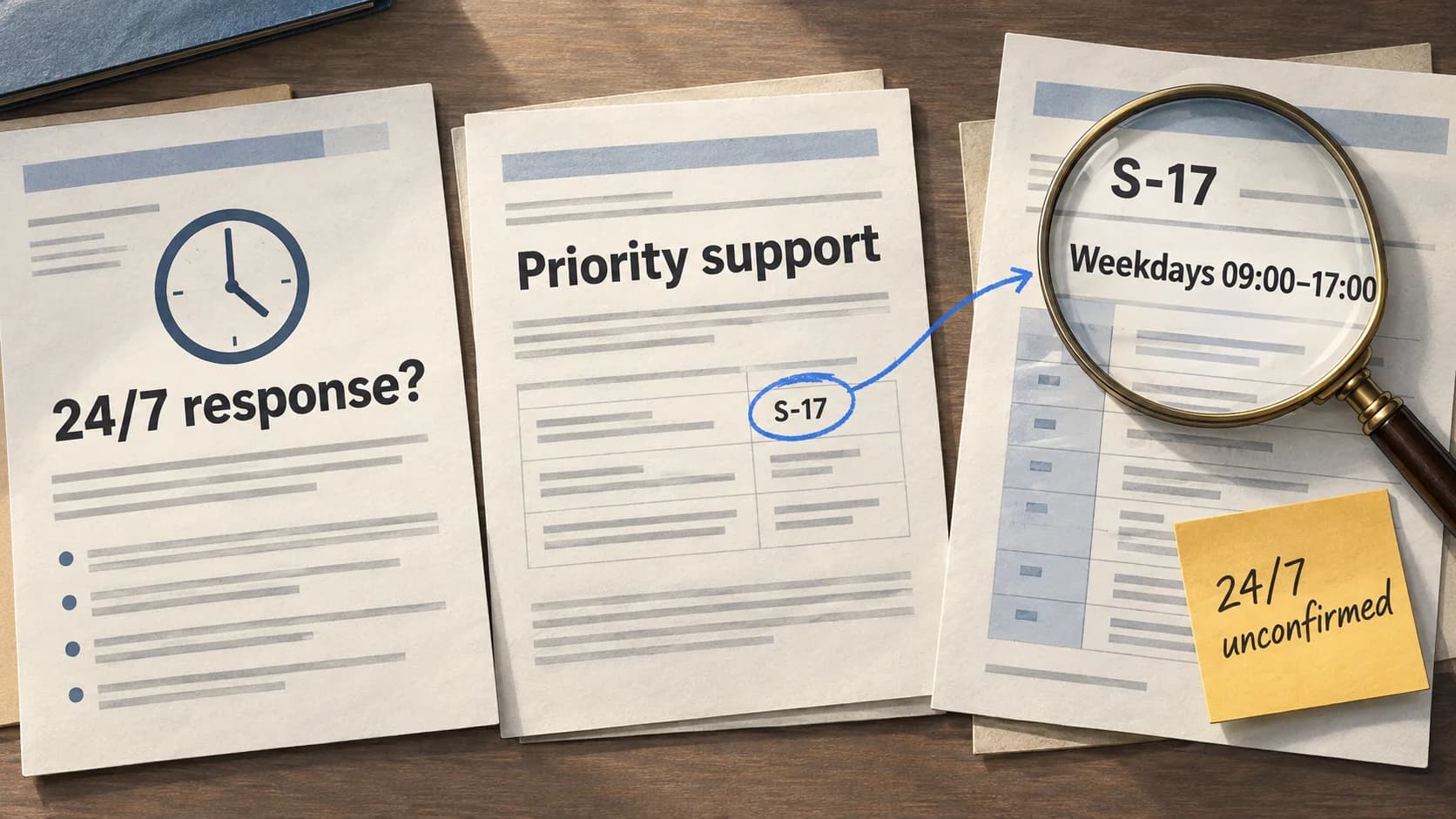
A bid manager asks whether their company can promise a response at any hour. The first search finds “Priority support.” Is that enough evidence for a 24/7 commitment?
Agentic RAG lets an AI system choose follow-up searches based on what it discovers. It can follow a document reference, investigate a contradiction, or identify a gap before preparing an answer.
The buying question is whether that investigation improves the result enough to justify its cost and delay.
What changes with agentic RAG?
In a common RAG pipeline, software retrieves relevant material and asks a model to answer from it. An agentic approach gives the model tools to decide what to retrieve next and whether further evidence is needed. NVIDIA's agentic RAG documentation describes planning, reformulated searches, synthesis, and optional verification.
This adds a decision loop around retrieval. It can use the same governed search service described in our retrieval infrastructure guide. It does not require replacing your index or adding several agents.
A tender review where the second search matters
Consider this fictional example, with invented documents and terms:
The tender requires a 30-minute response, 24 hours a day. Can we substantiate that promise for this customer?
First search: find the support arrangement. An account summary says “Priority support” and references schedule S-17. That establishes which schedule to inspect. It does not establish response hours.
Second search: follow S-17. The schedule specifies a 30-minute response during weekdays, 09:00–17:00. It says out-of-hours cover requires a separate agreement.
Third search: look for that agreement. Within the authorised customer records, the system finds no agreement covering the requested out-of-hours service.
The useful output is a review note:
- Supported: a 30-minute response within the stated weekday hours, citing S-17.
- Unconfirmed: the tender's 24/7 requirement; no supporting agreement was found in the searched records.
- Next step: ask the service owner to confirm coverage or propose an exception before submission.
The system should identify which records it searched. Failure to find an agreement does not prove none exists elsewhere. It must leave that gap visible and stop before promising coverage or submitting the bid.
The follow-up search is useful because the first result supplies the reference needed to investigate further. A well-designed conventional pipeline could also retrieve these documents; the example illustrates a reason to test adaptive search, not proof it will outperform your existing system.
When is a simpler approach enough?
Choose against the work:
- A direct question with a clear source: conventional RAG may be sufficient, such as finding a published returns period.
- The same checks every time: a fixed workflow may be easier to test, such as always checking a customer's plan, schedule, and signed amendments.
- The next source depends on what turns up: agentic retrieval is worth testing, such as following an unfamiliar schedule reference or resolving conflicting records.
Extra exploration takes time and can chase irrelevant material. Anthropic's context engineering guidance describes that tradeoff and hybrid approaches that combine initial retrieval with further exploration when needed.
Put limits around the investigation
The agent still depends on parsing, useful search, current sources, and access controls. Repeated searches cannot recover a document that never entered the system or that the user cannot access.
Set a search budget, time limit, permitted sources, and stopping rule. For the tender example, stop when each requirement has supporting evidence or a clearly recorded gap. Escalate unresolved conflicts instead of looping indefinitely.
Enforce document permissions in the retrieval service. Treat instructions inside retrieved files as untrusted content. Keep research tools read-only unless a separate, explicitly authorised action is part of the workflow. Our agent workflow guide covers those operating boundaries.
Make the extra searches earn their cost
Compare your existing approach and the proposed agent on the same representative questions, with the same source versions and permissions. Include easy questions, misleading summaries, missing evidence, and conflicting documents.
Measure:
- Evidence quality: are the answer and its citations correct, with gaps identified?
- Reviewer effort: how long does a person need to verify and correct the output?
- Operating cost: model usage, searches, elapsed time, and support effort.
- Boundary behaviour: does the system stop and preserve access limits?
Anthropic's evaluation guide recommends defined success criteria and multiple trials because outputs vary. Keep evaluation cases separate from the examples used to tune the system.
Start with one question where your current search loses the thread. Inspect whether following the evidence produces a better reviewed answer. If the same result comes from a simpler retrieval fix, use that.
For help evaluating that first workflow, bring representative documents and expected answers to our AI agent development team.


